
Annotated Bibliography of the WITCH HUNTS
(15th-17th Century)
Buy the Book!
Buy the Book!

See
also the syllabus for HIST/WMST 425 The Witch Hunts: 1400-1800 for
Spring 2004
DISCLAIMER
|
|
Annotated Bibliography of the WITCH HUNTS
|
|
|
|
The most useful books in English that help explain understand the overall phenomenon of the Witch Hunts are listed right below. After the line break are more specialized studies and works of varying quality annotated largely by students of varying ability. At the bottom of the page are listed collections of primary sources, the best way to learn about the witch hunts.
I would suggest that the reader/researcher always be wary of books that lack a scholarly apparatus (footnotes or endnotes), accept uncritically the worst accusations of feminists or atheists, and/or suggest that demonically empowered witches actually existed.
Barry, Jonathan, Marianne Hester, and Gareth Roberts, ed. Witchcraft in Early
Modern Europe. Past and Present Publications. Cambridge, UK: Cambridge
University Press, 1996.
Collection of essays and articles of
witch scholarship.
Farrington, Karen. Dark Justice: A History of Punishment and Torture. New York:
Smithmark, 1996.
A more popular, but readable and accurate history of the larger issues of
justice, but has some good coverage, with informative illustrations about the
witch hunts.
Klaits, J. Servants of Satan: The Age of the Witch-hunts. Bloomington, Indiana: Indiana University Press, 1985.
Excellent survey of issues of the witch hunts.
Levack, Brian, P. The Witch-Hunt In Early Modern Europe. London: Longman,
1987.
This study is the best scholarly overview of the hunts. It may be too
advanced for the general reader, but provides excellent scholarship and coverage
of both general issues and some specific hunting activities.
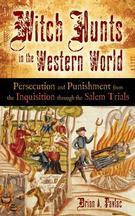
Pavlac, Brian A. Witch Hunts in the Western World: Persecution and
Punishment from the Inquisition through the Salem Trials. (Westport, CT:
Greenwood, 2009; Lincoln, NB: Bison Books, 2010).
(In the webmaster's humble opinion) a readable survey suitable for a general
or beginner audience which surveys witch-hunting according to various countries and regions of Western Civilization.
Oldridge, Darren, ed. The Witchcraft Reader. London: Routledge, 2002.
An excellent collection of articles by historians and other researchers about
the witch hunts. The variety of perspectives and topics offers a useful
cross-section of recent research on the issues of witches.
Russell, Jeffrey B. A History of Witchcraft: Sorcerers, Heretics and
Pagans. London: Thames and Hudson, 1980.
A good brief survey of the whole issues of magic right up to the present.
The author offers some respect for current pagan practices, but is very careful
with historical descriptions.
Scarre, Geoffrey. Witchcraft and Magic in 16th and 17th Century Europe. Studies in European History. London: Macmillan Press, 1987.
Good, brief coverage of this limited period of the witch hunts.
Wiesner, Merry E. "Witchcraft," pp. 218-238 in Women and Gender in Early Modern
Europe. Cambridge, England: Cambridge University Press, 1993.
Excellent review of issues of the witch hunts as they relate to women's
history.
Adams, Gretchen A. The Specter of Salem: Remembering the Witch Trials In
19th Century America. Chicago: University of Chicago Press, 2008.
In The
Specter of Salem, Gretchen Adams examines the way Americans viewed and
interpreted the history of the Salem Witch Trials in America. Adams discusses
the political aspects of the witch hunts, their role in history, and the
cultural shock that these trials instilled in the residents of Salem,
Massachusetts. Religious crises are explained throughout Adams' book and turn
out to be very thought provoking and intuitive; the ones who started the
accusations of witchcraft did so to represent the cases of "persecution,
intolerance, and bigotry (3)." Note-worthy authors are used as examples in
Adams' book so as to not only establish her expert opinions but to back them up
with actual facts and expert secondary source references. In an interesting
aspect, Adams brings up the Civil War in her book to discuss how it and the era
of Reconstruction had an impact on the witch hunts and trials. Before the Civil
War southerners accused the North of having a society filled with episodes of
delusions, rebellious fanatics, and persecutions (54). Adams believes that the
geographic location of the witch hunts/trials most prominently affected how they
were handled; however, she also agrees that religious rebellion, disaster, and
social control played a role in the carrying-out and final results of the Salem
Witch hunts. This book was definitely an interesting and insightful read.
Annotation by Rebecca Brenner.
Almond, Philip C. The Witches of Warboys: An Extraordinary Story of Sorcery, Sadism and Satanic Possession. New York: I.B. Tauris, 2008.
Professor Philip C. Almond, University of Queensland, is a fine source in seeking to discover more information and a better idea of accounts in the witch hunts. He is highly respected
by his peers throughout the world for the work he has done in the field of religion. To back this statement up, he has written several books in this specific area such as Heaven and
Hell in Enlightenment England, England's First Demonologist: Reginald Scot and 'The Discoveries of Witchcraft' and Mystical Experience and Religious Doctrine: An Investigation of the
Study of Mysticism in World Religions (Religion & Reason). Within his book, The Witches of Warboys, he explains an account that took place in the Village of Warboys, England. The
book starts out explaining that the Throckmorton family had just moved to the town and was just getting to know the citizens of the town. When one of the daughters is stricken ill,
surrounding neighbors pay visits to show their concern, a common trend among Protestants. However, when one woman, Alice Samuel, visits, the sick daughter claims the older woman is a
witch. This sets off a devastating chain of events. Two more Throckmorton daughters fall ill and claim that Alice has too bewitched them. Soon Alice's daughter, Agnes is dragged into
this mess and eventually her husband, John, is accused of witchcraft. By the end of the story, the whole town is turned against the Samuel's by the three young Throckmorton's and the
Samuel women are second guessing themselves. The book spins a web with some twist and turns explaining just how dangerous the accusation of witchcraft can be and how it can change
people and alter the mind. Annotation by Christian Crinella.
Andreski, Stanislav. Syphilis, Puritanism and Witch Hunts. New York, N.Y.: St. Martins Press, 1989.
Andreskis book examines the impact of syphilis on Europe, the assumption that the disease was a product of witchcraft, and the gradual movement toward Puritanism in order to prevent its spread. The book also includes extensively researched background information that is helpful in understanding the ways in which syphilis ultimately contributed to the witch craze of the 16th and 17th centuries. Syphilis, Puritanism and the Witch Hunts provides an effective representation of how various social issues, when compounded, lead to mass hysteria.
Syphilis and other incurable diseases prevalent at that time were thought by
some to be the work of witches who gained power through devils. Andreski cites Henri
Boguet as believing that these incurable diseases, mainly syphilis, were caused by the witchcraft of the evil devils and incubi. Boguet
is quoted as writing,
"I maintain that they afflict people with all kinds of ills of the stomach and the head and the feet, with colic, paralysis, apoplexy, leprosy, epilepsy, dropsy,
strangury,
etc. And this they do easily with the help of Satan" (92). Edited from a review
by Mark Pisano.
Barstow, Anne Llewellyn. Witchcraze: A New History of the European Witch Hunts.
San Francisco, CA: Pandora, 1994.
A comprehensive history of the European Witch Hunts. Documents everything from the
events and people who started the Witchcraze to the punishments and torture in which those
convicted endured. This book also gives special attention to the treatment and
discrimination of women, and also has some interesting illustrations.
Annotation by Erin Nummey.
Bartel, Pauline. Spellcasters: Witches and Witchcraft in History, Folklore, and Popular
Culture. Dallas: Taylor Trade, 2000.
Bartel has 20 years of teaching experience and is the author of several books dealing with various topics in popular
culture. The book itself is well-written and well-researched, using dozens of sources including the
Malleus Maleficarum and many other books and articles. It deals with seven main topics: the origins of witches and witchcraft, the European witch hunts, the Salem witch trials, the appearance of witchcraft
today, important figures in witchcraft history, and the influence of witchcraft and witches on popular culture.
The book is not too in-depth on any one topic, but could give some knowledge to a person
who had no prior experience with witches or witchcraft. Annotation by Steve
Matusiewicz.
Boyer, Paul and Stephen Nissenbaum. Salem Possessed: The Social Origin of
Witchcraft. Cambridge, MA: Harvard University Press, 1974.
Paul Boyer and Stephan Nissenbaum are both associate professors of history at the University of Massachusetts,
Amherst who have authored several works dealing with Early American History.
They focus on the patterns of accusation focusing on status and geography, the quest for community and identity and the role of religion and ministers.
Salem Village did not have a legal existence apart from Salem Town, yet they were still taxed and still expected to take shifts on the nightly watch in Salem Town. Salem Village
was basically isolated, almost to the point of being inbred, in the sense that practically everyone was related through blood or
marriage which set the stage for the village, trials and executions. Ironically, the groups that had a significant hand in starting the trials also played a significant role in ending them. The book picks apart the reasoning of how the prayers and sermons of the church had failed to contain the outbreak of the trials and executions, yet the direct and organized intervention of the principal ministers of eastern Massachusetts succeeded.
Salem Possessed collects the most extensive primary sources to support the authorss thesis stating that the social issues plaguing Salem Village were mostly to blame for the suffering that went on there.
[Note reviews Thomas, Keith. New York Review of Books (1974): 21 and
Cowing, Cedric B. American Historical Review (1974): 47].
Edited from a review by Lori Castiglione.
Brauner, Sigrid. Fearless Wives and
Frightened Shrews: The Construction of the Witch in Early Modern Germany.
Amherst: University of Massachusetts Press, 1995.
Before her death in 1992, the author of this book, Sigrid Brauner, was a well-respected assistant professor of German literature at the University of Massachusetts, Amherst.
She asks in the book: Why were women singled out as witches for the first time in
history? She immediately answers the question by the Malleus
Maleficarum, which reinterpreted witchcraft as a gender-specific crime.
Next Martin Luther, although for the most part against the writings of the
Malleus, does go along with how devious witches are, and how they defy the Lord.
Other authors such as Paul Rebhun and Hans Sachs were a little more lenient about women and how they shouldnt be dismissed as much as witches.
Edited from a review by David Ruggles.
Clark, Stuart. Thinking with Demons: The Idea of Witchcraft in Early
Modern Europe. New York, NY: Oxford University Press, 1997.
Dr. Clark is a professor of early modern history at the University of Wales
Swansea who has published several books and articles on witchcraft and
demonology, including Languages of Witchcraft: Narrative, Ideology and
Meaning in Early Modern Culture, Witchcraft and Magic in Europe: The
Eighteenth and Nineteenth Centuries, and the soon to be released Biblical
and Pagan Societies (Witchcraft and Magic in Europe). This book is
more of an intellectual history of demonology than a history of witchcraft. The
book is divided into five sections: language, science, history, religion,
and politics. Each of the topics supports the idea that demonology was widely
accepted as part of the early-modern worldview and that, in light of those times,
it was a rational belief. [Note reviews of Black, Jeremy. History
Today, July 1998, 59-60 and Hindle, Steve. The Economic History
Review 51 ( 1998): 211-212]. Edited from a review by
Harry Lyons.
Davies, Owen. "Methodism, the Clergy and the Popular Belief in Witchcraft and
Magic." History. 82 (April, 1997): 252-265.
This article mainly deals with the concern the Methodists still had about the
prevalence of magic during the 2nd half of the 18th century and the
claims of the Anglicans that Methodists propagated superstitions in their parishes.
Although this book gave little information on the actual witch hunts, it gave a useful
perspective on the religious perspective on the issue of witches.
Annotation by Erin Nummey.
Decker, Rainer. Witchcraft and the Papacy: An Account Drawing on the Formely Secret Records of the Roman Inqusition. Translated by H. C. Erick Midelfort. Virginia: University of Virginia Press, 2008.
In 1880, Rainer Decker, a Director of History in Paderborn, Germany, gained limited access by Pope Leo XIII to the secret Vatican archive. Using Roman inquisitor documents, Decker brings to light the papacy's cautious involvement in witch hunts. The first nine chapters provide a chronological general analysis of witch craft from ancient pagan to medieval magic. In chapter ten, Decker argues four factors proving the papacy did not contribute to the rise of executions in western civilization. One, the papacy had limited awareness of trials outside of the Papal States. Two, some local bishops over-ruled papal innocent verdict and executed the individual. Three, civil courts conducted trials without local inquisitor. Four, local courts and church figures feared witches. In his book review, Dr. Michael D. Bailey states, "The entire papal total [executed witches] ranks below that of several individual early modern German 'super hunts'" (147). The Remaining chapters provide detailed analysis of specific locations and the papacy's involvement. Overall, Decker proves local courts and bishops are responsible for the rise in witch hunts. [Note the review Bailey, Michael D. "Witchcraft and the Papacy: An Account Drawing on the Formerly Secret Records of the Roman Inquisition"
Journal of World History, Volume 21, Number 1, March 2010, 145-147]. Annotation by Patricia Streeter.
Dillinger, Johannes. "Evil people" : a Comparative Study of Witch Hunts in Swabian Austria and the Electorate of Trier. Translated by Laura Stokes. Studies in Early Modern German History. Charlottesville : University of Virginia Press, 2009.
Johannes Dillinger compares the two regions of Swabian Austria and the Electorate of Trier, during the witch trials of the 1600s in Germany. Johannes Dillinger uses Karen Lambrecht and Monika Neugebauer-Wolk as important historians to help support his thesis of woman being the main target for the hunts. The ten theories of origin that is used in this text was the theory of Misogyny. At least 88 percent of the people executed for witch craft in these areas were women. He also discussed that the peasants and the witch hunting groups of the area would accuse "evil people" using some form of witch craft with very little evidence to support their claim. The theory behind this was most likely due to the people wanting to self-govern, a clear example of The Social Functionalist or Social Accusations Theory. Most of the claims that were brought up to the territorial governments were quickly thrown out due to the lack of evidence. Dillinger believed that the fear for witches was so strong, that even the smallest amount of evidence about witchcraft would be quickly blown out of proportion. Dillinger asserts that it "was no longer the witches but the witch hunters who were the 'evil people'"(200). Annotation by Patrick Skellington
Donovan, R. Frank. Never on a Broomstick. Harrisburg, PA: Stockpole Books, 1971.
Frank Donovans, Never on a Broomstick, covers the topic of the evolution of witchcraft, from prehistoric rituals, through the
Middle Ages, the witch hunt period, and modern practices. It gives detailed description about the contemporary beliefs we hold against witches. Donovan is very
negative toward Christianity and Judaism. Donovan criticizes the Church by saying that it
was the churchs fault that people turned to witchcraf, because it was too boring for and distant from the people.
So the nocturnal meetings of the witches Sabbat appealed more. In describing methods of torture used during the witch
hunts, Donovan gets very graphic. The book also covers topics including possession and the control of natural phenomenon and
weather. Annotation by Joseph Zubko.
Gardner, Gerald B. Witchcraft Today. New York N.Y.: The Citadel Press, 1955.
Gerald Gardner wrote this book to describe his knowledge of witches, based on
his own experiences in a coven in England. This is one of the basic modern texts
that have influenced contemporary pagan religions such as Wicca. Gardner points out the biggest misconception
is that witches do evil deeds for the devil. He said that they would never
magically harm another person, and that they perform rituals to different Gods.
Today, historians would not give much credit to the history which Gardner
presents for witchcraft through the ages. But, if someone wants to know what
some witches practiced in the 1950s, this book is very interesting.
Annotation by Jim Morgan.
Ginzburg, Carlo. Ecstasies: Deciphering the Witches' Sabbath. Translated by Raymond Rosenthal. New York, NY.: Pantheon Books, 1991.
Carlo Ginzburg is currently a professor of Italian Renaissance at UCLA, and is considered to be an expert in
microhistory, which is the study of a narrow section of a historic subject to find broader truths.
Ginzburg explains that the accounts of witchcraft that were tortured out of witnesses were false accounts. In reality the European culture at the time had shamanistic religions. The nocturnal meetings, flying, cannibalism, and other made up accusations were misinterpretations of real ecstatic rituals of these shamanistic societies. The cultural differences between the Italians and Celtic groups and those ethnic people in the Baltic regions sparked accusations of witchcraft, especially the creatures an practices contained in Friulian folklore( Ginzburg 161).
Ecstasies examines the remnants of the pre-Christian warrior cults identified in
Ginzburg's book I Benandanti (in English: The Night Battles: Witchcraft and Agrarian Cults in the Sixteenth and Seventeenth
Centuries, 1966). The Night Battles and shows how their ecstatic rituals and beliefs in mythical creatures, god and goddess worship was more than likely misunderstood and misinterpreted as witchcraft and evil doing. The creature in both books that is directly related to ancient European shamanism is the
werewolf, believed by European societies in the sixteenth and seventeenth centuries to be a type of bewitched person or
demon.
The terminology can get difficult making skimming virtually impossible at certain points.
Still, the book is an excellent text on the topic of witchcraft in the sixteenth and seventeenth century in
Europe, as it broadly describes cultural and societal differences. Annotation by
Marla Moses.
Ginzburg, Carlo. The Night Battles: Witchcraft
and Agrarian Cults in the Sixteenth and Seventeenth Centuries. Translated
by Anne and John Tedeschi. Baltimore: Johns Hopkins University Press, 1983.
In 1966 when Carlo Ginzburg published I Benandanti, now translated from
the Italian as The Night Battles, it was immediately hailed as a
groundbreaking work on the subject of witchcraft. Ginzburg has become known as
one of the chief proponents of microhistory in books such as The Cheese and
the Worms, which study a small slice of history intensely in order to find
larger truths. The Night Battles focuses on a group of peasants in the
Friulian countryside near Venice, and their inquisitors, over a seventy-year
period. The name benandanti translates awkwardly as "those who go
doing good," a vague name, and one that inquisitors found singularly
inappropriate. These men and women, who were born with the caul (amniotic sac
around the head), claimed to have gone out, at least in spirit, during the four
periods each year known as Ember Days and battled witches for the success of
crops. Ginzburg shows that most benandanti interrogations followed the
pattern of first evasiveness and denial on the part of the accused, who feared
being punished by the witches or by other benandanti for talking about
their combats. The accused were then either tripped up by the doggedness of the
inquisitors or the multitude of accusations against them. They made thorough, if
sometimes confused and reluctant confessions, and received sentences of various
penances and warnings not to engage in such activity in the future. Not one
trial ended with an execution. The impression we are left with is that the
judges considered the peasants too silly to have been heretics. The importance
of the benandanti trials is that they constituted to the inquisitors the
first real evidence of a witch conspiracy. The parallels between the case of a
17th century Livonian man condemned for believing that he became a wolf and the benandanti
lead Ginzburg to posit them both as surviving elements of an otherwise extinct
European fertility cult, although he does not entirely succeed in making the
case. [Note reviews Midelfort, H.C. Erik.
Catholic Historical Review 72 (1986): 648-650 and Burke, Peter.
New York Review of Books 32 (1985): 32-34].
Edited from a review by John Fitzpatrick.
Godbeer, Richard. The Devil's Dominion: Magic and Religion in Early New
England. Cambridge: Cambridge University Press, 1992.
In his book Godbeer looks at folk magic in the early days of New England and how it was viewed by the clerics of the day,
where religion and magic were sometimes intertwined. When the colonists came over from England they brought with them all their different beliefs and practices this included their own beliefs in magic, cunning folk,
healing, and divining. Most of the information in regards to magic is found in clerical sources and in legal depositions. The first witch trial,
1648, involved a woman named Margaret Jones whose neighbors admitted to having used countermagic to
identify her as responsible for the harm done to their livestock. Godbeer puts forth the idea that magic was such an everyday occurrence for people living in the sixteenth
century -- it was not really thought of as witchcraft, until someone pointed it out.
[Note reviews Morgan, Edmund S. "Beat the Devil," New York Review of Books, 28 May 1992, 40.and Pestana, Carla
Gardinia. Reviews of American History, 21 (
1993): 13]. Edited from a review by Sandra Silvey.
Gragg, Larry. The Salem Witch Crisis. New York: Praeger Publishers,
1992.
This book chronologically tells the story of the witch hunt and trials in
Salem. In the preface, the author says that, "This is an old-fashioned
approach, one based on the belief that history is first and foremost a good
story." The book is different from other accounts of the Salem hunts
because the author focuses on the impact that the people involved in the trial
had on shaping events. The book's thesis stresses that the witch hunters
actively shaped the prosecutions by their actions, rather than all of the
involved individuals being swept up in a snowballing and escalating phenomenon.
Gragg carefully shows how the judges and some townspeople were at first
reluctant to accept the idea that certain accused witches were guilty, and he
shows the process and rationale as to why they changed their minds. The book is
well-written and thoroughly researched, with reference notes at the end of every
chapter. Annotation by Kris Januzzi.
Hansen, Chadwick. Witchcraft at Salem. New York: George Braziller, 1969.
For his book, Hansen brings knowledge from the field of psychology to add a different angle to his interpretation of the trials.
Hansens view is that the girls as well as some of those who were accused of being witches were suffering from hysteria. What once was called hysteria is now called a somatization disorder or a somataform disorder. While it is quite possible that one or even a few people suffered from his rare psychological disorder, there is no way that it can be historically proven.
His other main purpose in the book seems to be to put the clergy of Boston in a more favorable light than previous history has done. He relays many stories about witch trials that took place in Europe so that the reader has information to compare the situation in Salem with that in Europe. However, his placement of these examples should have been more organized so as to make the book easier for readers. If one were to read only a single book on the Salem Witch Trials, I would recommend a more general book. While his interpretations are insightful, at times he takes them further than he should as an objective historian.
[Note the review Erikson, Kai. "Witchcraft at Salem: Were some of
those witches real?" The New York Times, natl. ed., 6 July 1969,
Sec. 7, 5]. Edited from a review by Jennifer Levisky.
Heinemann, Evelyn. Witches: The Psychoanalytical Exploration of the Killing of
Women. London: Free Association Books, 2000.
Evelyn Heinemann, a psychologist, psychoanalyst, and professor of special education at the University of Mainz, Germany, combines her interests in the witch-hunts along with her expertise in psychoanalysis to delve into the misogyny theory of the witch-hunts. Heinemann argues that in order to understand the brutal killing of women in the sixteenth and seventeenth centuries, one must also understand the unconscious processes of their persecutors. She argues that Freuds explanations of hysteria, possession, and fear of witches is problematic because it does not explain how the human imagination has the potential for such destructiveness inherent in the witch-hunts. This book is addressed to those with a background in psychology and the witch-hunts, however the chapters are filled with detailed explanations of key
Freudian terms. Her research is supported by an extensive bibliography. Heinemann concludes,
though, with a statement that confuses her overall point: there is only one way for women not to become victims of the imaginary power imagines seeking revenge for discrimination: Women have to attain real power, equality, and appreciation in society (143). In these last lines, Heinemanns focus
suddenly shifts from women accused as witches in early modern Europe, to a feminist argument addressing women as a whole in society today.
Annotation by Leslie Martin.
Hester, Marianne. Lewd Women and Wicked Witches: A Study of the Dynamics of Male
Domination. 2nd edition. New York: Routledge, 1992.
Hesters book examines the connection between male domination and the early modern witch-hunts. She takes a feminist approach, by arguing that men dominated women, using intercourse as a symbolic rape to show women that they were superior. Hester does not believe that men are innately aggressive, but she does believe that eroticized violence is inherent in their nature. Hester then applies this sexualized theory to the 16th and 17th century witch hunts that took place in England. She argues that the witch-hunts were specifically targeted at women because the male-dominated society
in a time of change felt that persecuting women was the only way to keep them passive and submissive. Her argument is for the Misogyny Theory as the main cause of the witch
hunts. She does not address the issues that men were also persecuted for
witchcraft, or that most of the witnesses against the accused were women. While the book was well- written and interesting, its attack on the male gender,
including the view of heterosexual relations as a violent and aggressive rape, seems a little fanatical.
Annotation by Eileen Dougherty.
Kieckhefer, Richard. "The Holy and the Unholy: Sainthood, Witchcraft, and Magic
in Late Medieval Europe." Journal of Medieval & Renaissance Studies. 24
(Fall, 1994): 355-85.
This article is a discussion of the relationship between sainthood, magic, and
witchcraft in late medieval Europe. The author talks about his belief that sainthood and
witchcraft are mirror images of each other. He believes that there are several
similarities in the literature about witches and saints. Although his point is an
interesting one to ponder, he says nothing about the widespread hunts in Europe.
Annotation by Erin Nummey.
Kieckhefer, Richard. Magic in the Middle Ages. New York: Cambridge University
Press, 1989.
This book deals with medieval magic during the years 500 to 1500. The majority of this
book deals with the social history of magic and how beliefs in magic affected the culture.
However, a small portion of it talks about how persecution of magic and witchcraft led to
changes in the law. Only one short chapter deals with the issue of womens persecution
during the witch hunts of Europe. Annotation by Erin Nummey.
Kittredge, George, Lyman. Witchcraft in Old and New England. New York: Russell
and Russell: 1929.
Kitteredge, who was a
professor at Harvard, explains that witchcraft was not brought to Europe by learned people, but the struggling masses who clung to their ancient
beliefs. However, once the beliefs of witches came to Europe, everyone had a hand in spreading the black art. He tells stories of people dying, supposedly, from a witch sticking pins in a doll,
or cows that lost their ability to give milk, or witches turning into cats, magic potions, and other mysterious
happenings to show the silliness in the belief in witchcraft. Kitterdege
calls the notorious witch trials in Salem, Massachusetts a
"mere incident" in the annals of history (328)." [Note reviews Gorman, Herbert. "Once it was Reasonable to Believe in Witchcraft."
The New York Times Book Review, 17 March 1929, 4 and Knight, Marion A. and Ruth N.
Lechlitner, ed. "Kitteredge, George Lyman."
Book Review Digest. New York: H.W. Wilson Company, 1930, 520-521].
Edited from a review by Matthew Fisher.
Kluckhohn, Clyde. Navaho Witchcraft. Beacon Press, Boston. President and Fellows of Harvard College, 1944.
Clyde Kluckhohn graduated from the University of Wisconsin, then studied at both Oxford and at the University of
Vienna, becoming a Professor of Anthropology at Harvard University. Collection of data for this book started in 1923 when he
interviewed 93 Navaho, of whom some 38 had expertise in the folklore of witchcraft.
The first part of the book contains general data about all kinds of witch phenomenon.
The second part, the Interpretation, looks at the value and disruptive effects of such Navaho
witchcraft beliefs and practices. Last, an Appendix consists of stories told about
witchery. Navaho witchcraft differs from the European witchcraft. First, Navaho witches
were never hunted in an organized way. Second, while Navaho witches are frowned upon on but not as much as in Europe, nor is bad magic done as much.
There have been few witch killings; in five hundred informants only two have been executed.
All witches were men. This book would be recommended to those trying to compare
between different areas, or cultures of people using sorcery. Annotation by
Glenn Zimmerman.
Kunze, Michael. Highroad to the Stake.
Michael Kunze is an outstanding lyricist and librettist of the German musical
theater.In this book, Kunze recreates the events that led to the execution of a poor Bavarian
family, the Pappenheimers. That family lived in the 1600s and traveled around Germany emptied privies for a living,
and survived along with committing petty crime. Kunze describes in great detail
how they were arrested, tortured, put on a show trial, and then publicly executed by being
tortured and burned alive at the stake.Kunzes interpretation of the real reason the Pappenheimers died was not to protect the people from the evil of the Devils minions, but to make Duke Maximilian I appear to be a living example of the Christian monarch.
The citys Catholic faith and a crime wave in the vast countryside with no way of stopping
it led to a "spectacular display, which ran counter to his notorious
meanness"(p.110). From the clothing to the architecture, it gives a
good visual of what Munich was like in the sixteen hundreds. The book was awarded the 1981 Faculty Prize by the Munich University Law School, and was also translated into several languages.
Reviews: Paul Roberts, "A first whiff of the Holocaust," review of Highroad to the Stake, by Michael Kunze,
The Toronto Star, 18 April 1987, M9; Wendy Doniger O,Flaherty, "Agony and Apostasy," review of Highroad to the Stake, by Michael Kunze,
The New York Times, 19 April 1987, 14. Edited from an
annotation by Thomas Flanagan.
Leonard R.N. Ashley. The Complete Book of Magic and Witchcraft.
New York: Barricade Books, 1986.
Leonard R.N. Ashley, a professor of English at Brooklyn College, produces all of the knowledge he has gathered in his many years of studying magic and witchcraft in this lengthy volume. The book contains elements of every type of magical happening known to human kind. The book takes a rather skeptical look at magic, summed up in one particular line
"Whether what is subjectively produced [magic] has also an objective reality, the true believer cannot
tell" (pg. 10). He gives little to the person studying the witch-hunts, as he dedicates only one chapter to the subject.
The main strength of the book is it presents all the information as detailed
passages, spanning the globe from Europe, to Asia, to Jamaica and the United States. He basically explains what is believed to occur to persons who encounter magic, or dabble in the occult.
Annotated by Brian Hazlak.
Levack, Brian P. Witch-Hunting in Scotland: Law, Politics, and Religion. N.Y.: Routledge, 2008.
With the first majorly comprehensive work on the witch hunts in Scotland since Christina Larner, Dr. Brian Levack focuses his attention on the volatile nature of witch hunting in this region from the early modern period to the eighteenth century. Through his comparison of English and Scottish witch-hunts, Levack defies the Social Control Theory by showing that the central government was pivotal to ending the hunts. He reasons that the Scottish hunts came about because of issues with law (the majority of trials were conducted by people with no judicial experience or training), politics (hunts and accusations tend to be higher during periods of political uncertainty or grave crisis), and religion (Scottish witchcraft was defined in primarily religious language). Portions of the book were spent detailing the effect of King James VI on the first wave of major Scottish witch hunts and how that precedent affected the hunt of 1661-1662. Levack also makes sure to focus on how Scottish hunters were particularly concerned with demonic possession and the Witch's Mark. The Mark brings about an interesting issue with the use of prickers, men specialized in poking the accused with needles until the mark was found. Using effective case studies of actual trials and outcomes, Levack clearly defines the issues that lead to such severe witch hunts and to its eventual end. Annotation by Jennifer Momenzadeh.
Macfarlane, Alan D. J. Witchcraft in Tudor and Stuart England. New
York: Harper and Row Publishers, 1970.
This work concentrates on witchcraft prosecutions in three villages of Essex
County, England, between 1560 and 1680. Macfarlane provides numerous statistics
from ecclesiastical and secular trials on the gender, age and social status of
the accused and the convicted, as well as the types of punishments endured by
those deemed guilty. He discusses the relationships of the accused to their
accusers and attempts to explain the motivations which spurred neighbors to
become suspicious of and press charges against one another. He proceeds to list
reasons for the decline of witch trials in Essex by the middle of the 17th
century. Finally, Macfarlane compares/contrasts notions about witchcraft in
Essex with those held by other Europeans, American Indians and Africans. The
alleged witchcraft in this part of England was considerably less colorful and
more practical than elsewhere in continental Europe. They were, in fact, accused
of injuring/killing or attempting to injure/kill people and their property,
invoking evil spirits, seeking out treasures and lost items with the aid of
magic, and various methods of fortune telling. It appears that the major factors
in determining the guilt or innocence of an Essex witch were the character of
his parents, his drinking habits, his friendships and general reputation (17). Concerning
the root causes for prosecution, he dismisses as unproven untrue or problematic
causes such as destitution, illness, or religious fervor. Instead, Macfarlane
suggests that the Essex witch trials responded to how the elderly strained
economic resources and caused friction between themselves and younger families,
keenly felt in Tudor and Stuart England, where ideals of charity were beginning
to change (163-164). Also, Macfarlane suggests that tensions between neighbors,
such as being refused some charity. Accusing someone of witchcraft was a way to
divert guilt from one's self onto someone else. Macfarlane explains the eventual
decline of witch trials in Essex by pointing to changes that occurred over the
course of the 17th century, such as the establishment of workhouses.
Across Africa and America, as in Essex, witches were typically middle aged to
old, generally outsiders on the fringes of society, nonconformists. Witchcraft
in Tudor and Stuart England was one the first books to zero in on the
phenomenon of the witch hunts in a small region wherein they were well
documented. Critics praised Macfarlane's scrupulous, scientific approach. Reviews:
Lewis, I. M. "Witchfinders." The Economist, 23 Jan. 1971, 51;
Stone, Lawrence. "The Disenchantment of the World" The New
York Review of Books, 2 Dec. 1971, 17. Edited from a review by
Jennifer York.
Monter, E. William, ed. European Witchcraft. New York, Wiley [1969].
Some edited classic secondary articles about the witch hunts, also with a few
primary sources.
Norton, Mary Beth. In the Devil's Snare. New York: Alfred A. Knopf, 2002.
In the book, In the Devil's Snare, the author Mary Beth Norton, a professor of history at Cornell University, provides a new theory that reveals the Salem Witchcraft Crisis of 1692 was a result from the mental trauma that occurred after the King Williams War and the King Philips War, also called the First and Second Indian
Wars. Nortons book would fall under the Illness Theory, because the accusers were mentally traumatized by the Indian wars. Many of the accusers were connected in some way to these wars, whether
they experienced the devastation first hand, or had family members who were involved.
When Abigail Williams and Betty Parris first accused Tituba, Samuel Parris Indian
slave, she was a symbol of the Indians tormenting New England. Norton helpfully
explains the crisis chronologically, in daily and weekly intervals, as events
unfolded. She uses many primary sources, like the court archives from Essex County, along with many secondary sources. Where there is missing information Norton fills it in with her opinions on what may have happened.
Even people familiar with the subject of the Salem Witchcraft Crisis could find this
book useful. Annotation by Dana Romano.
Notestein, Wallace. A History of Witchcraft in England from 1558-1718. New
York: Russell & Russell, 1965.
This book gives a very comprehensive history of Witchcraft from the years 1558-1718. It
gives a detailed explanation of the origins of witchcraft. It also offers something most
of the other sources do not. It talks about several different rulers during that period,
such as, Elizabeth I, James I, Charles I, Charles II, and how they dealt with the supposed
threat of witchcraft. It also gave a lot of information pertaining to the woman's issue
of witch hunts, explaining the proportion of women to men in witchcraft indictments, and
contains a chapter about widows, and spinsters. Annotation by Erin Nummey.
O'Connor, Patrick Joseph. "Witchcraft pamphlets in Renaissance England: A
Particular Case in Which the Tale was Told." The Midwest Quarterly
37
(Winter, 1996): 215-227.
This is an examination of the literature of English witchcraft. The writer explains
that witchcraft trials and cases in Renaissance England were reported in pamphlets. He
analyzes a couple of these pamphlets and asserts that they highly influenced the publics
acceptance of the outlandish charges giving specific examples to help the reader better
understand how such a large number of people were convinced that witches actually existed
and needed to be punished. Annotation by Erin Nummey.
Diane Purkiss. The Witch in History: Early Modern and Twentieth-century
Representations. NY: Routledge, 1996.
This book attempts to provide a more feminist outlook on the time of the
witch hunts. The book argues that witch stories were used for women to express
ideas and feelings that were simply not socially acceptable. The author asks
that the reader to read the myths of witches as literary works. Purkiss does an
excellent job of handling the emotions of the women who lived in a time of
repression, and gives good proof that the witch folklore was a way that allowed
these women to exercise a power that they had been denied before. In one
instance, Purkiss writes: "Having a reputation for witchcraft is seen as
something that is done to a woman, not seen as something they do. Women
involved with witchcraft entered vigorously into a struggle to control the
meaning of their own lives" (145). In other words, women used witchcraft to
express themselves in a time where women had very little influence in a largely
male dominated society. Diane Purkiss is listed as a lecturer at the University
of Reading and Fellow and Tutor at Keble College, Oxford. Her other
publications include At the Bottom of the Garden, Renaissance Women, and
Women, Texts and Histories 1575-1760. Annotation edited from a review by
Clark Gallo.
Robisheaux, Thomas. The Last Witch of Langenburg: Murder in a German Village. New York: W.W. Norton & Company, 2009. Thomas Robisheaux is a Duke University professor specializing in medieval and early modern European history. He received his undergraduate education at the University of Virginia and Received his PhD. at Duke University. The main purpose of Robisheaux's book is to discuss a singular accusation of witchcraft in Germany and how it affected the town as a whole. It follows the case of Anna Schmieg. She is accused of poisoning a pregnant neighbor through a shrove cake during the neighbor's sit in time after giving birth. Eventually Anna is put to death and the reader is left to ponder Anna's guilt or innocence. The book was written more as a story and less as a scholarly source. It was easily understandable and was written more for the common reader than a scholar. The mystery of guilt is one of the major positives of the book. However, this can also be a negative and be difficult to decipher Anna's true role in the witch hunt. While allowing the reader to make their own decision it does not give hard evidence if Anna poisoned her neighbor. Annotation by Amanda Daczka.
Rose, Elliot. A Razor for a Goat. Toronto: University of Toronto
Press, 1962.
This book is largely outdated, but very useful. Within his introduction he
declares his spiritual faith as an Anglican, while he admits his disbelief in
the Devil as well as magical powers. Rose identifies the four major schools of
thought concerning the witch-hunts. He ends up constantly referring to the
beliefs of the two most legitimate and popular of the four groups at the time of
this books publication, the Murrayite and the Anti-Sadducee, Bluff, and the
Knowing party. The Murrayite contention, of which is the most popular at
the time of this books release in America, declares that witches met at
gatherings to worship old pagan gods and that the worship predated Christianity
and was in no way a mockery of it. Rose justly pokes holes in the Murrayite
point of view throughout this book. The Anti-Sadducee takes the
supernatural acts of alleged witches as fact, showing a devil-worshipping
counter-culture against the dominant political and religious influence of
Christianity. Rose describes the remaining two schools of thought as instinctive
reactions to thrilling superstition. The Bluff school attributes the entire
witch-hunting phenomenon to delusional thinking and mass hysteria in the Middle
Ages. The Knowing school believes in passed down, secret knowledge and focuses
on the Black Masses or Sabbats. Elliot Rose believes that the four schools
of thought have to learn to ask the right questions to pursue their hypotheses
under the context of history. Elliot Rose was a lecturer at the University of
Toronto in the Department of History. Annotation edited from a review by Peter
Kizis.
Rosenthal, Bernard. Salem Story: Reading the Witch Trials of 1692. New York, N.Y.: Cambridge University
Press, 1993.
A professor of History at the State University of New York- Binghamton, Rosenthal claims that the
Salem Witch Hunt resulted from fabricated accusations that snowballed into a far-reaching phenomenon. His approach in this book is different from other Salem books because he clears up many myths that have surrounded the witch trials.
Using Salem Witchcraft Papers by Paul Boyer and Stephan Nissenbaum, the author
describes the situation in Salem as a festival of finding witches, as anyone was susceptible to accusations. Being an accuser was the only safe haven during this time. Rosenthal rejects the common idea that there was one theory for the witch
hunts. Rosenthal felt that the situation did not occur as a result of some hysterical or mentally ill girls or youthful teenagers who
consumed bad rye (ergot poisoning) and began to hallucinate nor does he give much support to the notion of the character of
Tituba. This person's identity has morphed over time: once thought to be Native American,
Tituba is now considered to have been African. Rosenthal also dispels the idea that only females were
accused, as various men, including Reverend George Burroughs were accused and convicted of witchcraft.
Not one person who was convicted and executed of witchcraft during the Salem hunts was burned at the stake.
He states that because women were first accused and because of stereotypes towards women, historically
they are seen as the only accused and convicted of witchcraft in Salem. Through his detailed accounts of what happened, he shows us that the Salem Witch Trial could happen again in different forms. Arranged in chronological order,
this book is an excellent source of information about the Salem witch-trials. Although the books contents
are an excellent scholarly source for accounts and material about the witch-trials of 1692, Rosenthal has
not included a bibliography. Annotated by Eric Calabrese and Christine
Collins.
Russell, Jeffery Burton. Witchcraft in the Middle Ages. Ithaca: Cornell University, 1972.
Russell received his Ph.D. from Emory University and has written four other books involving
religious dissent in the Medieval Ages. He notes that no serious historian wrote
on this witchcraft before 1905. Russell proves his amount of research with dozens of footnotes throughout the book and a 31 page bibliography.
The main focus of his book is on how Christianity helped bring about witchcraft. He begins with events occurring around
300 A.D. when Christianity recognized Paganism as a threat. As the medieval
Western Church grew in size, affluence, and authority, the degree of the witch crazes elevated. He describes the true wrath of the hunts beginning in 1360. He believes the severity of the witch hunts were directly due to those who tried to resist movements of the Church, which would explain why so many women and Jews were seen as easy targets for being prosecuted.
The hunts also spread during the Late Middle Ages, because Christians
increasingly emphasized the Devil and his powers. The Devil had gone from being
God's lonely opponent to a giant, commanding, cosmic beast whose power rivaled
God's. Witchcraft in the Middle Ages proves to be good reading, if a little biased
due to the amount of time he takes discussing the Church. Annotation by E. Frank
Skawinski.
Schulte, Rolf. Man as Witch: Male Witches in Central Europe. New York: Palgrave Macmillan: 2009.
Rolf Schulte is an historian at the University of Kiel in Germany whose work has primarily centered on the witch hunts. This book looks at the treatment of men in regards to accusations and punishments for witchcraft. Schulte uses surviving primary source transcripts to portray several examples of trials involving males charged with witchcraft. The author also uses tables and figures to statistically show the number and proportion of men compared to women who have been charged or convicted of witchcraft throughout different regions of Central Europe. Schulte also deduces the different reasons men were targeted, including their age, social status, and behavior. The author also concludes that mass trials played a large role in the number of men charged. Schulte argues that several different methodological issues including change over time, regional differences, and the role that Catholic belief in diabolism played regarding an increase in male persecutions in the 17th century. This books contrasts the gender theory by showing that women were not the only victims of the witch hunts. Annotation by Kevin Pryor
Sebald, Hans. Witch-Children from Salem to Modern Courtrooms. Amherst, NY: Prometheus Books, 1995.
Hans Sebald's book Witch-Children from Salem Witch-Hunts to Modern Courtrooms is an in-depth look at the role children have played throughout the western world from the beginnings of the hunts up to the present time. The book is split up into three parts. Sebald states in the introduction that those three parts will examine historical data, a case study, child psychology, and the implications on modern life. His historical data is accurate and the sources are quite well documented and the case study on the Witchboy is a great example of the chaos found in that time period. However, his remarks on child psychology make it seem like suggestibility is their one guiding force. Even in Sebald's case study on the Witchboy something else seems to be going on other than the boy being edged into believing he is possessed. Despite this, Sebald brings about several connections between modern day courtrooms and the witch hunts. The questioning of children and the belief that what they say is accurate in sexual abuse cases and murder trials is certainly something that needs to be analyzed. Annotation by Joshua Philips.
Simpson, Jacqueline. "Witches and Witchbusters." Folklore. 107
(1996): 5-18.
This journal identifies some themes in literature about recent witchcraft, and compares
them to both the written history and literature pertaining to witch hunting in Europe
during the 16th century. This is not the best source for research on witchcraft
but does provide insightful information concerning witches in literature.
Annotation by Erin Nummey.
Starkey, Marion L. The Devil in Massachusetts. Garden City, New
York: Doubleday& Company, 1969.
The Devil in Massachusetts describes in sequence the people and
events that surrounded the Salem Witch Trials. It is written in a narrative
format, like a novel, but adds that it is not fiction, it is American history. I
think that is what makes it more enjoyable to read. The theory surfaces
that these bored young women, living in times that tended to be boring because
life consisted of working to eat, were looking for some type of drama in their
life. Through all the frustration that had built up inside of the people in
town, the final count ended at twenty people dead for crimes that they did not
commit. At the end of the book she has her notes and her primary source the
Essex County Archives. She also has a selected bibliography of her sources and
many secondary sources that she used to research. Annotation edited from a
review by Matt Gingo.
Thomson, Janet A. Wives, Widows, Witches and Bitches: Women in 17th
Century Devon. New York: Peter Lang Publishers, 1993.
The title reflects the categories into which women of the period were cast
by patriarchal society. After Thompson provides the reader with some general
knowledge of the time she proceeds to break the chapters down accordingly:
Female Alehouse Keepers in Seventeenth-Century Devon, Defamation Cases and
Sexual Slander in Seventeenth-Century Devon, Witchcraft in Devon, and Women and
Property in Seventeenth-Century Devon. Society at this time showed the
characteristics of a Dichotomy: Women were alleged by men to be
intellectually inferior, disordered, unruly, lustful, and often evil in nature.
Biased men made these allegations against the women of the Devon societies.
Thompson did extensive research in court records of the Diocese of Exeter and
the quarter sessions of Devon, as well as books of the borough sessions for
the less well-studied towns of the county. The author is a contributor of
articles to periodicals and anthologies, including Historical Dictionary of
Stuart England 1603-1689. Reviews: Platt, Wilfred. Historian
58 (1996): 702; Contemporary Authors. 150 (1996): 435-436;
Wiesner, M. E. Choice, November 1994, 515-516. Annotation
edited from a review by Kristopher Atkinson.
Whitney, Elspeth. "International Trends: The Witch "she"/the
Historian "he": Gender and the Historiography of the European
Witch-hunts." Journal
of Women's History. 7 (Fall, 1995): 77-101.
Points out that little attention has been paid to exploring the relationship between
the European witch-hunts of the 16th and 17th centuries and issues
relating to gender. The author believes that most written about the subject deals with
economic and social issues rather than the women's issue. She also believes that further
research into the topic should point to new directions for approaching the hunts. More
effective for the study of the historiography of witch-hunts than actual research on the
topic. Annotation by Erin Nummey.
Willis, Deborah. Malevolent Nurture. Ithaca: Cornell University Press, 1995.
This book approaches the subject from the standpoint that feminine, or rather maternal characteristics played a large role:
the witchs maternal traits that gave her malevolent power, so it was a largely gender-related
crime. She gives an introduction to the book by discussing a brief history of the witch
trials. She then described the (female) witch: usually older and postmenopausal.
She draws on the works of psychoanalyst Melanie Klein and her theory involving pre-Oedipal
conflict, that children naturally grow to resent their mothers when their ego-related needs are not sufficiently satisfied. So, in a sense, though the witchs mothering capabilities suffer for her biological child, she instead uses her maternal capacity to nurture the
Devil. To help illustrate her ideas, Willis uses the historical character James VI of Scotland.
His somewhat conflicted relationship with his biological mother, Mary, Queen of Scotland and his
"mother-like" relationship to his older cousin, Elizabeth of England made him a prime example for Willis
use. The author also calls on the works of William Shakespeare, paying special attention to
Macbeth. While Professor Willis clearly states her points and supplies ample documentation,
She has, as I see it, left out the one crucial piece that may invalidate her
argument: why did the practice of witchcraft at that magnitude simply appear, then disappear, only a short time later?
Willis is a professor at the University of California, Riverside. [Note
reviews Clark, Stuart. Shakespeare Studies 24 (1996): 340-347,
Bever, Edward. Journal of Social History 30 (Summer 1997): 995-997].
Edited from a review by Sarah McKelvy.
Winn Carlson, Laurie. A Fever in Salem: a New Interpretation of the New England Witch
Trials. Chicago: Ivan R. Dee, 1999.
Winn Carlson, who has a masters degree in History from Eastern Washington University,
uses medical evidence to explain the behavior of the Salem community during the witch trials of 1692.
Her hypothesis is that many accusers were ailing from encephalitis lethargica (xvi). The author compares the symptoms of the supposed victims of witchcraft in Salem to an outbreak of encephalitis lethargica that occurred between 1916 and 1930 (76). The book is set up into eight chapters, with the main
comparative evidence in chapters two and five. The author is a firm believer in the disease theory of the witch hunts, and tries to discredit the misogyny, mass hysteria, and social conflict theories (115-118). She uses over fifty secondary sources and over forty primary sources, most notably
Awakenings by Oliver Sacks, which presented the physical behaviors of patients who suffered
from encephalitis lethargica during the Twentieth-Century epidemic (98). Winn Carlson does an admirable job of creating a book that is easy to read and has a smooth continuous flow.
I would recommend this book for someone with an advanced knowledge of the Salem witch trials, particularly for someone with a scientific background. I would caution a beginner to read this book with some skepticism and to explore other avenues
about the causes of the Salem witch trials. Annotation by Jonathan
Grochowski.
Source Books
Breslau, Elaine G., ed. Witches in the Atlantic World: A Historical Reader & Primary
Sourcebook. New York: New York University Press, 2000.
Good collection of primary sources, well-mixed with classic secondary articles.
Kors, Alan Charles and Edward Peters, ed. Witchcraft in Europe 400-1700: A Documentary
History. 2nd ed. Philadelphia: University of Pennsylvania Press, 2000.
Probably the best current collection of primary sources with good introductory
commentaries.
Levack, Brian P., ed. The Witchcraft Sourcebook. London: Routledge, 2004.
Another good collection of primary sources with introductory commentaries.
Monter, E. William, ed. European Witchcraft. New York, Wiley [1969].
Mostly edited classic secondary articles, but a few primary sources, such as the
Malleus Maleficarum, a judgment on the witch Walpurga Hausmannin,
Records of the witch-persecution at Bamberg, and a letter against witches, by
Cyrano de Bergerac.
For links to primary sources online go to the annotated links page.
|
Annotated Bibliography |
  |
|
URL: http://departments.kings.edu/womens_history/witch/witchbib.html |

